


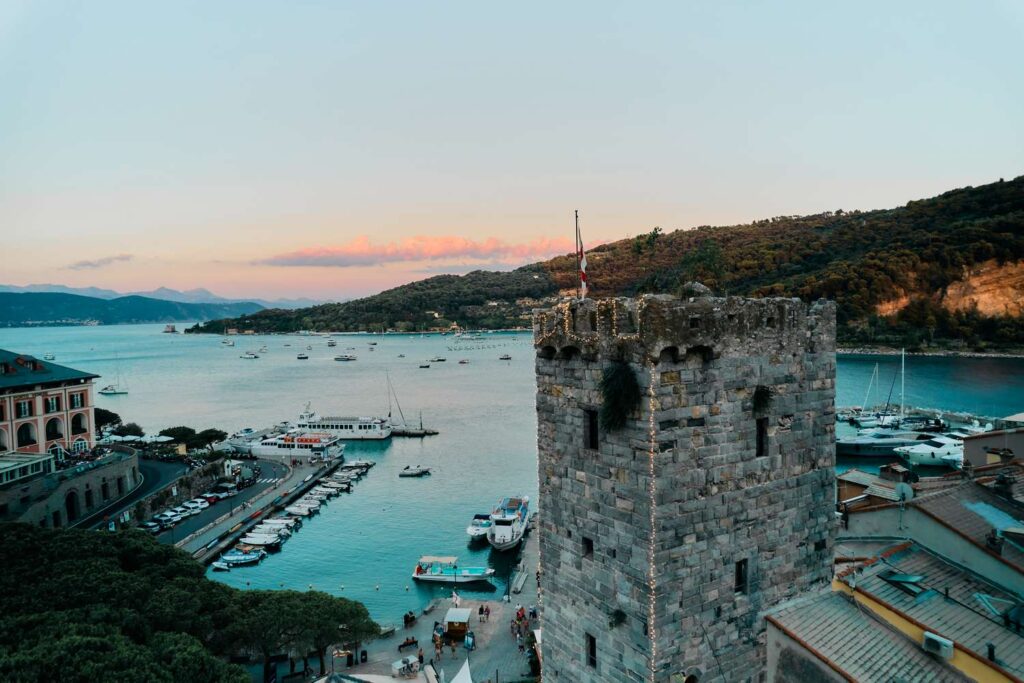
Updated 11 November 2026
At a glance
- Portovenere, the Cinque Terre and the islands of Palmaria, Tino and Tinetto form a single UNESCO World Heritage Site, inscribed in 1997 as a cultural landscape.
- Italy has 62 sites on the World Heritage List, more than any other country: the latest was added in July 2026.
- UNESCO recognised the way people here have built villages and terraces on a steep coast for a thousand years, without breaking the balance with the sea.
- The Genoese built Capitolare Tower between 1113 and 1161: it was the first tower in the village of Portovenere and guarded its main entrance.
- Today it is a private suite for one party at a time, up to four guests: a way to sleep inside the UNESCO site, right next to the medieval gate.
- Experiences not to miss: the boat trip around the three islands, the loop walk around Palmaria, the Alta Via trail that starts at the foot of the Tower, and Tino, open only for the feast of San Venerio.
Why Portovenere, Palmaria and the Cinque Terre are a UNESCO World Heritage Site
On 5 December 1997 the World Heritage Committee inscribed the site “Portovenere, Cinque Terre, and the Islands (Palmaria, Tino and Tinetto)” on the List. It did not honour a single monument but a whole landscape: the Ligurian coast from the Cinque Terre to Portovenere, with the three islands off the headland.
The site meets three of UNESCO's criteria. It shows a traditional way of life that has lasted a thousand years and still sustains the local economy. It is an outstanding example of how small villages, layered over the centuries, were built in relation to the sea. And it is a fragile landscape, shaped by generations of work on steep, difficult land.
Today it is protected by two parks: the Cinque Terre National Park, created in 1999, and the Porto Venere Regional Nature Park, which includes the headland and the islands. Together they cover the whole site.
Among Italy's UNESCO sites, which rose to 62 in July 2026, this one has something special: it is a lived-in landscape. People live, work and sleep in the narrow lanes of Portovenere and the Cinque Terre, and the terraces are still farmed by hand.
Read the site's page on the UNESCO website
Discover how the Genoese fortified Portovenere
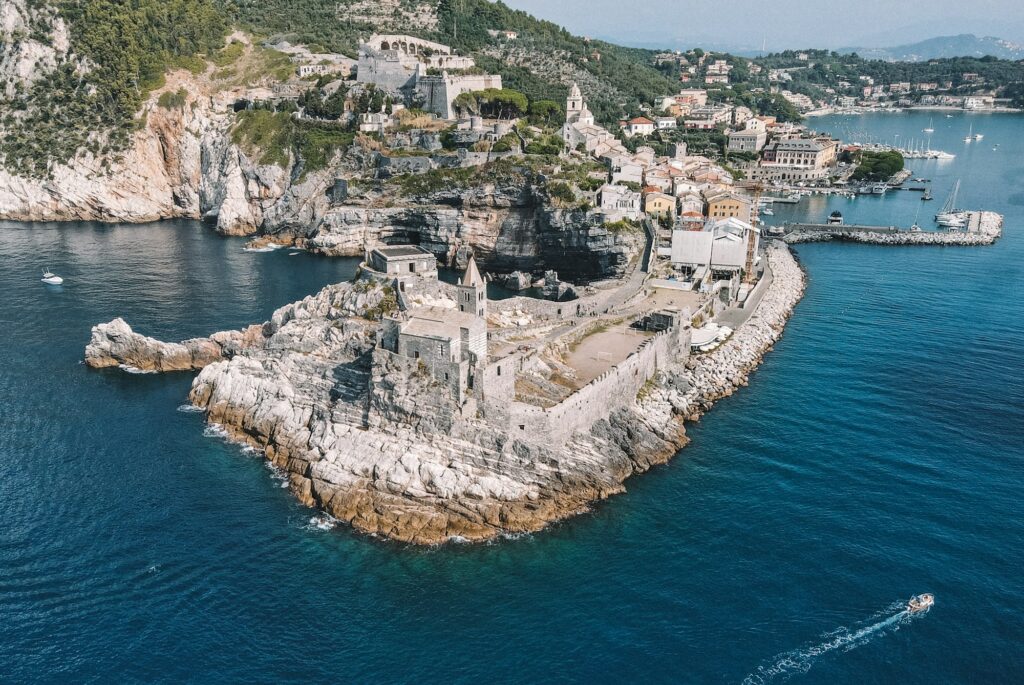
Portovenere was already a harbour in Roman times, the Portus Veneris. In 1113 the Republic of Genoa bought it from the lords of Vezzano and made it its outpost against Pisa, its great rival at sea. An inscription on the village gate still recalls it today: “Colonia Ianuensis 1113”, Genoese colony.
The Genoese enclosed the village within a ring of walls, built from 1160 onwards, and turned it into a fortress. The tall, narrow houses facing the harbour, joined one to the next, formed a wall towards the sea. Higher up they built the castle, in 1161, and the church of San Lorenzo; on the rocky point stands the church of San Pietro, rebuilt in the Genoese Gothic style with black and white bands.
The village withstood many sieges. In 1494 the Aragonese fleet bombarded it and caused serious damage; in the 17th century Genoa added new defences, including the Torre Scola, on the rock off Palmaria. Two centuries later the poets arrived: according to tradition, Byron used to swim in the cave below San Pietro, which now bears his name.
What to see in Portovenere in two days
Step inside Capitolare Tower, the sentinel of the village gate
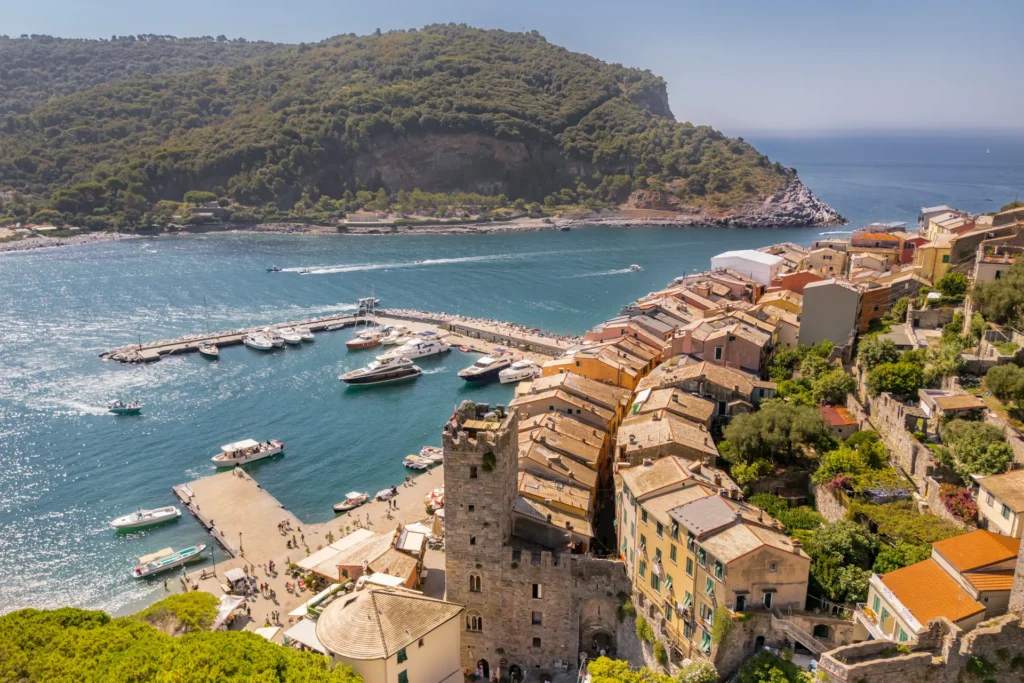
Anyone arriving in Portovenere by land enters the old village from Piazza Bastreri, through the medieval gate. Beside the gate stands Capitolare Tower: the first tower the Genoese built in the village, between 1113 and 1161, to defend its main entrance.
It is a square tower of local grey stone, with walls of dressed blocks and two- and three-light windows on the first floor. From the top you can see the harbour, Palmaria and the road into the village: the right place to keep watch over anyone coming in. The stone still bears the marks of the fighting the tower has witnessed.
Near the gate you can still see the old Genoese measures: white marble basins carved with the arms of Genoa, used to measure goods. One reads “meza barile de vino di Genova de pinte 40 de l'anno 1606”: half a barrel of Genoese wine, 40 pints, from 1606.
The Tower stands inside the perimeter of the UNESCO site. For a long time it belonged to the State and stood closed and abandoned. Restoration began in 2020, respecting the heritage constraints, and in 2022 the Tower opened its doors again, this time to guests.
Visit Palmaria, Tino and Tinetto
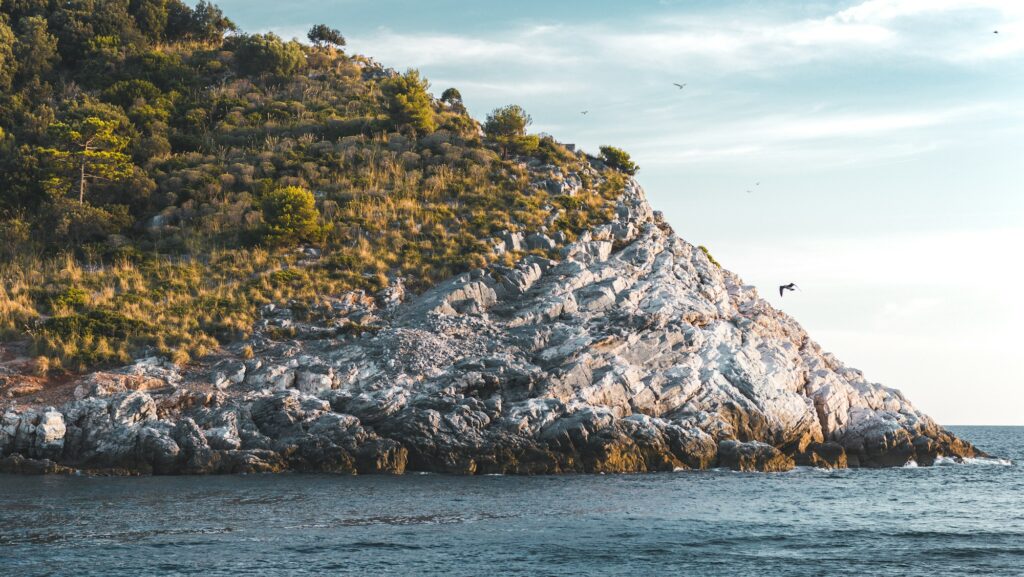
Off Portovenere, across the channel known as Le Bocche, lie the three islands of the UNESCO site. Palmaria is the largest island in Liguria, at 1.89 square kilometres, and you reach it in a few minutes by boat: the local boatmen make the crossing all year round.
The best way to get to know it is trail 510, the loop around the island: about three hours among Mediterranean scrub, forts and cliffs. On the west side, facing the open sea, are the Grotta Azzurra, which you can only visit by boat, and the Grotta dei Colombi, where prehistoric human and animal remains have been found.
To the south, at Pozzale, are the abandoned quarries of Portoro, the black marble veined with gold: “the rarest marble in Italy”. Inside the Tower you will find it again in the table of the main room.
Tino is a military zone, with the San Venerio lighthouse, lit since 1840, and the remains of the abbey dedicated to the monk who lived on the island and died there in 630. It can only be visited for the feast of the saint, patron of the gulf: in 2026 boats ran on 11, 12 and 13 September, with compulsory booking.
Tinetto, the smallest, keeps the ruins of an early Christian oratory and an 11th-century church, and is home to a lizard found nowhere else.
Gulf of Poets, Italy: what to see in Portovenere, Lerici and Tellaro in 2027
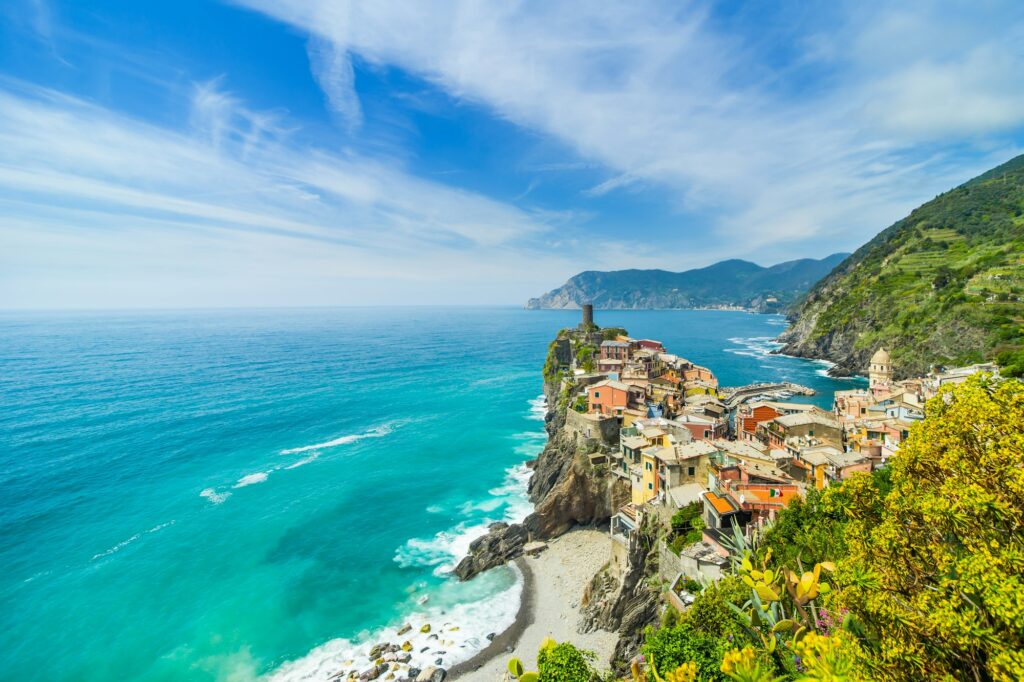
Walk among the terraces of the Cinque Terre
From Portovenere the Cinque Terre are close at hand: Riomaggiore, Manarola, Corniglia, Vernazza and Monterosso. Their landscape is the greatest work of the UNESCO site: about 6,729 kilometres of dry-stone walls, built by hand to carve farmable terraces out of slopes that drop straight into the sea.
The terraces grow Bosco, Albarola and Vermentino vines, which make Cinque Terre DOC wine and Sciacchetrà, a sweet wine made from grapes left to dry. When a terrace is abandoned, the walls give way and the slope slides: that is why the National Park helps farmers rebuild them.
The most beautiful way to get there is by sea, or on foot: the Alta Via delle Cinque Terre starts right in Piazza Bastreri, at the foot of the Tower, and climbs towards Campiglia and Telegrafo, from where you descend to Riomaggiore.
How to visit the Cinque Terre in 2027
Via dell'Amore in 2027: how to book, tickets and opening hours
Live the UNESCO site: 7 experiences not to miss
To truly experience this UNESCO site you need time and a slower pace. These are the experiences we recommend to our guests, with where they start and the best time to go.
| Experience | Starting point | When |
|---|---|---|
| Boat trip around the three islands | Portovenere harbour | By ferry in season, by private boat on request |
| Walk around Palmaria, trail 510 | Palmaria island, by boat from Portovenere | Spring and autumn, about 3 hours |
| Alta Via trail to Campiglia and Riomaggiore | Piazza Bastreri, at the foot of the Tower | All year, in good weather |
| Visit to Tino and the San Venerio lighthouse | Portovenere or La Spezia, booking required | Around 13 September |
| Procession of the Madonna Bianca | Old village of Portovenere | 17 August, in the evening |
| Via dell'Amore at sunset | Riomaggiore | All year, with a ticket |
| Sunset by private boat in front of San Pietro | Portovenere harbour | Booking required |
Indicative periods, based on the 2026 season.
If you are short of time, choose the sea: the trip around the three islands passes the Torre Scola, the caves of Palmaria and the Tino lighthouse. At sunset the light sets the harbour houses and the church of San Pietro aglow: it is the most beautiful moment of the day.
On 17 August Portovenere celebrates the Madonna Bianca: in the evening the village is lit up and the procession winds its way to San Pietro. On 13 September, for San Venerio, a procession at sea carries the saint's statue from La Spezia to the island of Tino.
Book a private sunset boat trip from Portovenere
Discover the boat tour to the Cinque Terre and Portofino
Portovenere and the Cinque Terre by boat
Sleep inside the UNESCO site, at Capitolare Tower
Staying at Capitolare Tower means having the whole tower to yourself: it is a private 128-square-metre suite for one party at a time, up to four guests. It is the oldest tower in the world you can sleep in.
From the roof terrace you see the harbour, Palmaria and the village entrance, just as the Genoese sentinels did in the Middle Ages. Breakfast and covered parking are included, the Tower is open all year and, on request, a chef cooks dinner for you in the room with the Portoro table.
As soon as you step out of the door you are already inside the UNESCO site: in a few minutes on foot you reach San Pietro, the castle and the pier where boats leave for the islands and the Cinque Terre.

Frequently asked questions
When did Portovenere become a UNESCO World Heritage Site?
On 5 December 1997, together with the Cinque Terre and the islands of Palmaria, Tino and Tinetto. The site is inscribed as a cultural landscape, under criteria ii, iv and v.
Is Capitolare Tower a UNESCO World Heritage Site?
World Heritage status applies to the site as a whole, that is the landscape of Portovenere, the islands and the Cinque Terre. Capitolare Tower stands inside the perimeter of the site, at the entrance to the medieval village.
Can you sleep inside a UNESCO World Heritage Site in Italy?
Yes. Many of Italy's UNESCO sites are lived-in towns and villages. In Portovenere you can sleep in Capitolare Tower, the 12th-century tower that guarded the entrance to the village, now a private suite for up to four guests.
How do you get to Palmaria island from Portovenere?
By boat, in a few minutes. The harbour boatmen make the crossing all year round, and in season there is also a scheduled ferry. On the island you get around on foot.
When can you visit the island of Tino?
Only during the feast of San Venerio, around 13 September, because for the rest of the year it is a military zone. In 2026 visits took place on 11, 12 and 13 September, with departures from Portovenere and La Spezia and compulsory booking.
How many days do you need to see Portovenere, the islands and the Cinque Terre?
At least three: one day for Portovenere and the island boat trip, one for the Cinque Terre by train or boat, one for Palmaria or the Alta Via. With four nights you also have time for a day at the sea.
Sources: UNESCO World Heritage Centre (decision 21 COM VIII.C of 1997 and site page 826), UNESCO-ICOMOS mission report of 2012 (parks of the site), Italian Ministry of Foreign Affairs (62 Italian sites, July 2026), Italian General Catalogue of Cultural Heritage (Porta del Borgo and town walls), lecinqueterre.org (history of Portovenere, Palmaria, Alta Via and dry-stone walls), Wikivoyage (Palmaria and Tino), Discover Portovenere (history of the village and San Venerio 2026), A Compagna (Genoese measures at the Porta del Borgo). Cover photo: Capitolare Tower at sunset, with the harbour and Palmaria.


